How temperature changes usable battery capacity
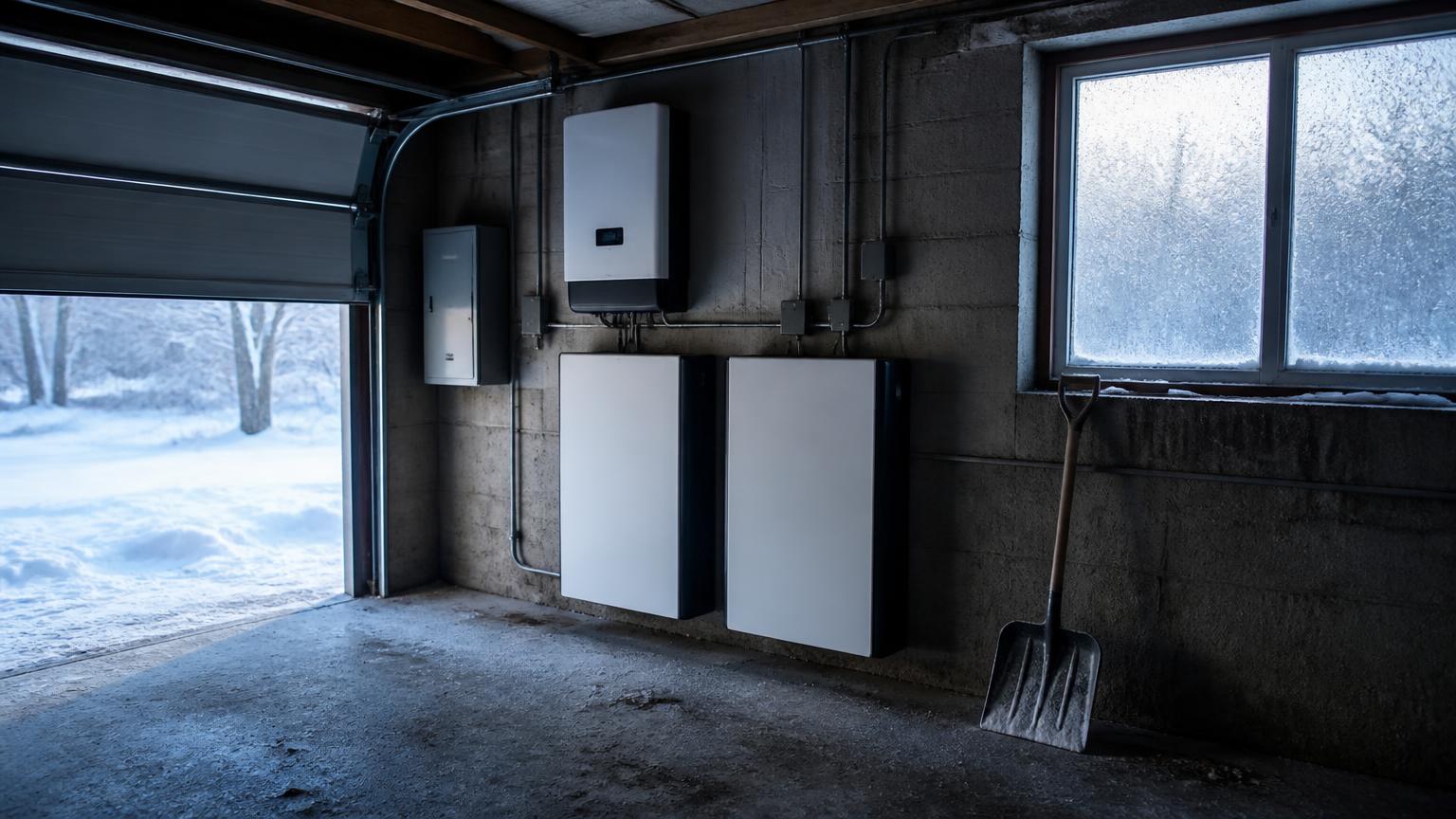
A battery in an unheated garage in January is not the same battery the datasheet describes.
Published 23 August 2026 · Published by SnapEnergyLab. Methodology and default assumptions are documented separately.
Quick answer
Battery capacity is quoted at a laboratory temperature of about 25 °C. A pack in an unheated garage in January is colder, slower and holds less energy that it can actually deliver — typically 15–25% less around −10 °C for lithium chemistries, and considerably worse for lead-acid.
The loss is mostly reversible: warm the pack and the capacity returns. Charging a cold lithium battery is a different matter, and that damage is not reversible.
- Rated at
- 25 °C
- Sourced value
- Typical loss at −10 °C
- 15–25%
- Illustrative model
- Charging below 0 °C
- Usually blocked
- Sourced value
Why cold reduces deliverable energy
A battery’s energy is stored chemically and released by ions moving through an electrolyte. Cold electrolyte is more viscous and ion movement slows, which raises the cell’s internal resistance.
Higher internal resistance has two consequences. Voltage sags further under the same load, so the pack hits its low-voltage cut-off earlier and reports itself empty with charge still inside. And more of the energy that does come out is dissipated as heat inside the cell rather than delivered to your load.
This is why the effect is load-dependent: a cold battery discharged very gently may lose almost nothing, while the same battery under a heavy surge load may cut out at what it thinks is 30% state of charge.
Show the plotted values
| Cell temperature | Available capacity |
|---|---|
| -20° | 70% |
| -10° | 80% |
| 0° | 88% |
| 10° | 95% |
| 20° | 100% |
| 25° | 100% |
| 35° | 100% |
| 45° | 98% |
Charging in the cold is the real hazard
Discharging a cold lithium battery costs you capacity temporarily. Charging one below roughly 0 °C can plate metallic lithium onto the anode, which permanently reduces capacity and, over time, creates an internal short-circuit risk.
For this reason most quality battery management systems simply refuse to accept charge below a threshold, and better home and vehicle batteries include self-heating that warms the pack before charging. If your system reports “not charging” on a cold morning while the sun is up, this is usually the reason — and it is the BMS doing its job.
Lead-acid tolerates cold charging, but its charge voltage should be temperature-compensated: charging a cold lead-acid battery at a warm-weather voltage undercharges it and accelerates sulphation.
- cold-weather usable energy (kWh) = nominal capacity × DoD × inverter efficiency × temperature factor
- example at −10 °C:
- 10 kWh × 0.90 × 0.92 × 0.82 = 6.79 kWh
The temperature factor is a derating you take from your own battery's datasheet. The 0.82 above is an illustrative value, not a specification.
Worked example: a garage battery in winter
- Nominal capacity10 kWhYour input
- Depth of discharge90%Site default
- Inverter efficiency92%Site default
- Usable at 25 °C8.28 kWhCalculated result
- Temperature factor at −10 °C0.82Illustrative model
- Usable at −10 °C8.28 × 0.82 = 6.79 kWhCalculated result
- At a 300 W essentials load6.79 ÷ 0.30 = 22.6 hCalculated result
Practical steps
Site the pack indoors where possible. A utility room or heated basement removes the problem entirely and costs nothing.
Insulate, do not seal. Battery enclosures need ventilation; an insulated but ventilated cabinet keeps self-heating from normal operation inside.
Check for a heating function. Many outdoor-rated home batteries and EVs draw a small amount of energy to pre-warm before charging. That energy is real and appears in your consumption.
Do not fight the BMS. A refusal to charge cold is protection, not a fault.
Apply your own derating
Reduce the capacity input by your datasheet’s cold-weather factor and compare the runtime against the same system at room temperature. The difference is what a winter outage actually costs you.
Open the battery runtime calculatorAssumptions and limitations
- The capacity curve is an illustrative model of typical LFP behaviour, not measured data for a specific battery. Use your manufacturer's derating table where one exists.
- Capacity loss depends strongly on discharge current: gentle loads lose far less than heavy or surge loads at the same temperature.
- Cell temperature is not air temperature. A pack that has been working generates its own heat and may be well above ambient; a pack that has sat idle overnight will not be.
- Lead-acid chemistries lose considerably more capacity in cold than the lithium figures shown here.
Sources
- IEC 62620 — Secondary lithium cells and batteries for industrial applications — International Electrotechnical Commission
Supports: Rated capacity is declared at a specified test temperature, conventionally around 25 °C.
- Battery test manual for stationary energy storage — U.S. Department of Energy / Idaho National Laboratory
Supports: Deliverable capacity of lithium-ion cells decreases at low temperature and recovers on warming.
Related guides
 BatteriesRuntime formulaUsable energy divided by load. The formula is trivial; getting the two inputs right is where runtime estimates fail.
 BatteriesDepth of dischargeDepth of discharge is the difference between the number on the spec sheet and the energy you are allowed to take out.
 BatteriesCapacity vs powerEnergy and power are separate limits. A battery can hold plenty of energy and still fail to start a well pump.