Battery capacity vs inverter power
Energy and power are separate limits. A battery can hold plenty of energy and still fail to start a well pump.
Published 23 August 2026 · Published by SnapEnergyLab. Methodology and default assumptions are documented separately.
Quick answer
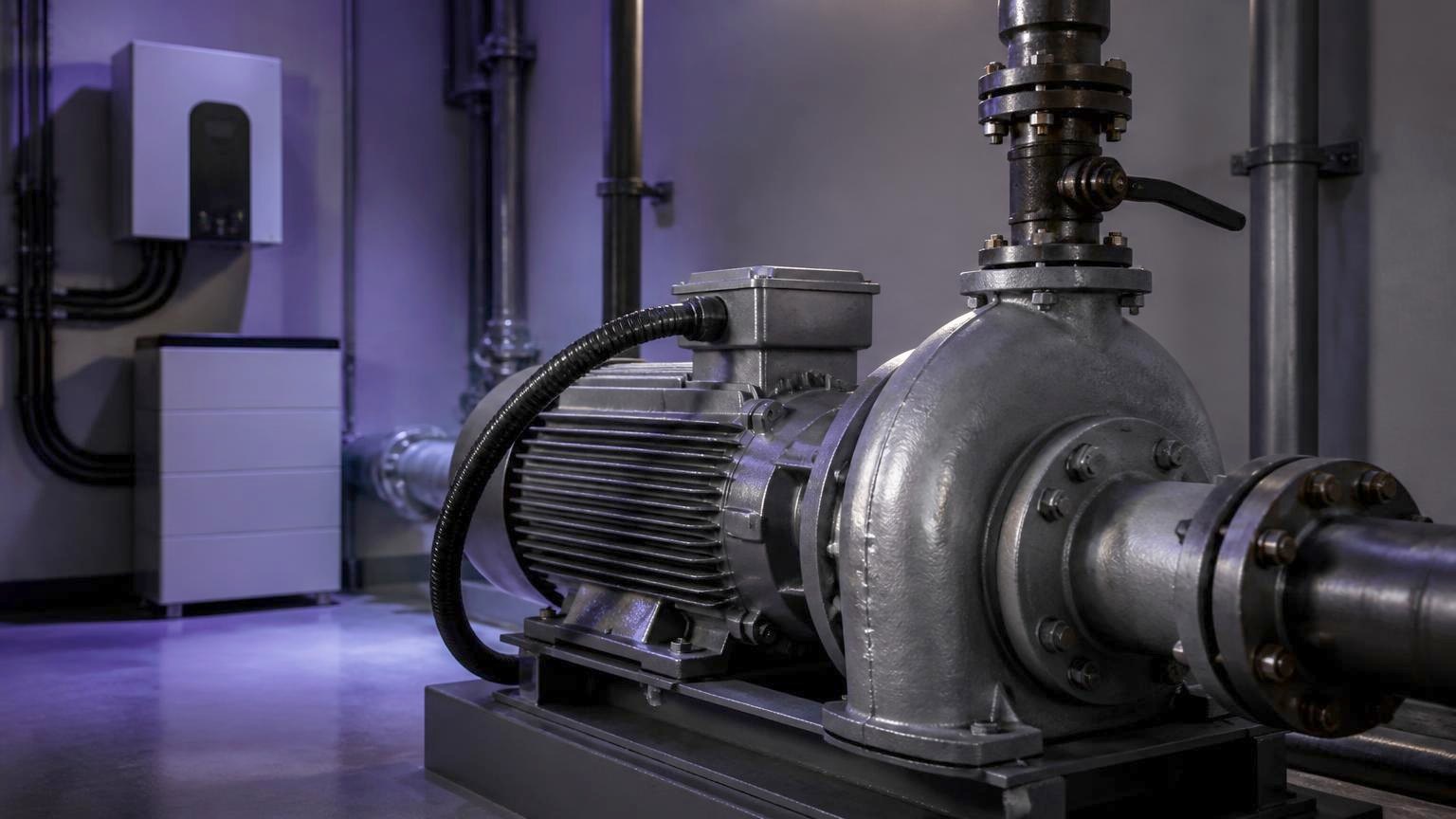
Energy and power are separate specifications, and they fail in different ways. A battery with plenty of kilowatt-hours cannot start a well pump if the inverter cannot supply the pump’s inrush current — the system trips within a second, with the battery still nearly full.
Check three numbers before trusting a backup design: stored energy, continuous power, and surge power for a few seconds. Runtime arithmetic only answers the first.
- Energy limit
- kWh — how long
- Sourced value
- Power limit
- kW — what at all
- Sourced value
- Surge limit
- kW for seconds
- Sourced value
Three limits, three questions
- energy limit : usable kWh ÷ average load (kW) = runtime (h)
- power limit : sum of simultaneous running watts ≤ inverter continuous rating
- surge limit : largest starting surge + other running loads ≤ inverter surge rating
- battery limit : continuous power ≤ pack C-rate × nominal voltage × capacity
All four must pass. The one that fails first determines what the system can actually do, and it is rarely the energy limit.
The fourth line catches a case people miss: the battery itself has a discharge current limit. A 5 kWh pack rated 0.5C can supply only about 2.5 kW continuously, no matter how large an inverter you attach. Pairing a 10 kW inverter with a small, low-C-rate pack buys nothing.
Starting surge is the usual failure
Anything with an induction motor — compressors, pumps, older air conditioners, some power tools — draws a locked-rotor current several times its running current for a fraction of a second while the rotor accelerates. Three to eight times running power is normal.
Inverters advertise a surge rating, typically 1.5–2× continuous for a few seconds. That headroom is what absorbs motor starts, and it is consumed by whatever else is already running when the motor starts.
| Appliance | Running | Typical starting surge |
|---|---|---|
| Refrigerator compressor | 150 W | 600 – 1,200 W |
| Freezer compressor | 120 W | 700 – 1,400 W |
| Circulation pump | 80 W | 240 – 500 W |
| Well pump, 1 hp | 750 W | 2,500 – 6,000 W |
| Submersible sump pump | 500 W | 1,500 – 3,500 W |
| Air conditioner, non-inverter | 1,200 W | 3,600 – 7,000 W |
| Microwave (as drawn, not cooking power) | 1,400 W | 1,400 – 1,800 W |
| Resistive space heater | 1,500 W | 1,500 W (no surge) |
Worked example: a 3 kW inverter and a well pump
- Already running: fridge, freezer, lighting160.5 W average, 270 W when both compressors runIllustrative model
- Well pump running power750 WIllustrative model
- Well pump starting surge≈ 4,000 WIllustrative model
- Peak demand at the moment of start270 + 4,000 = 4,270 WCalculated result
- Inverter continuous rating3,000 WYour input
- Inverter surge rating (2× for 5 s)6,000 WYour input
What reduces the power problem
Soft starters. Fitted to a compressor or pump, they cut inrush by roughly half and are far cheaper than a larger inverter.
Inverter-driven appliances. Modern inverter fridges, heat pumps and air conditioners ramp up instead of switching on hard, and have almost no surge.
Load shedding. A managed backup panel prevents the biggest loads from running together.
Honest scoping. Deciding that the well pump is not a backup load is a legitimate engineering answer, and usually the cheapest one.
Check running, average and surge power together
Select the loads you want to keep running and see all three figures at once — running power, average power for runtime, and worst-case surge — against four common battery sizes.
Open the backup builderAssumptions and limitations
- Surge figures are typical ranges for the appliance class, not measurements of your equipment. Motor inrush varies with motor design, load and supply voltage.
- Inverter surge ratings are specified for a limited duration and at a stated temperature. A hot inverter in a warm cupboard may not deliver its rated overload.
- Life-safety equipment — medical devices, sump pumps protecting a property, heating in freezing conditions — should be sized by a qualified installer, not from a web calculator.
Sources
- IEC 62040 — Uninterruptible power systems, performance and test requirements — International Electrotechnical Commission
Supports: Separate specification of stored energy, continuous output rating and overload capability.
- NEMA MG 1 — Motors and generators — National Electrical Manufacturers Association
Supports: Locked-rotor starting current of induction motors, several times rated running current.
Related guides
 BatteriesRuntime formulaUsable energy divided by load. The formula is trivial; getting the two inputs right is where runtime estimates fail.
 Batteries10 kWh ≠ 10 kWhDepth of discharge and inverter conversion take their share before a single appliance sees any energy.
 BatteriesTemperature effectsA battery in an unheated garage in January is not the same battery the datasheet describes.